
Get the Interview · Insights
How your CV/resume gets read
10 hiring manager behaviours you have to cater to

Rich Rosser, Founder
I've sat in the room with over 1,000 hiring managers as they decided who to interview – and who to reject. My team reviews 1,000+ CVs every week, helping hiring managers not overlook the best-fitting candidates.
Here's what those meetings taught me: most CVs fail for the same reason. Not because the candidate is weak – because the CV is written for the wrong reader. It's written for an imagined careful judge who reads every line. That reader doesn't exist.
The real reader is a busy hiring manager who didn't want this task, gives it seconds, and decides fast. Below are the ten behaviours I've watched play out a thousand times. Once you see them, you can't unsee them – and your CV will never look the same.
10 common behaviours of hiring managers when reading your CV
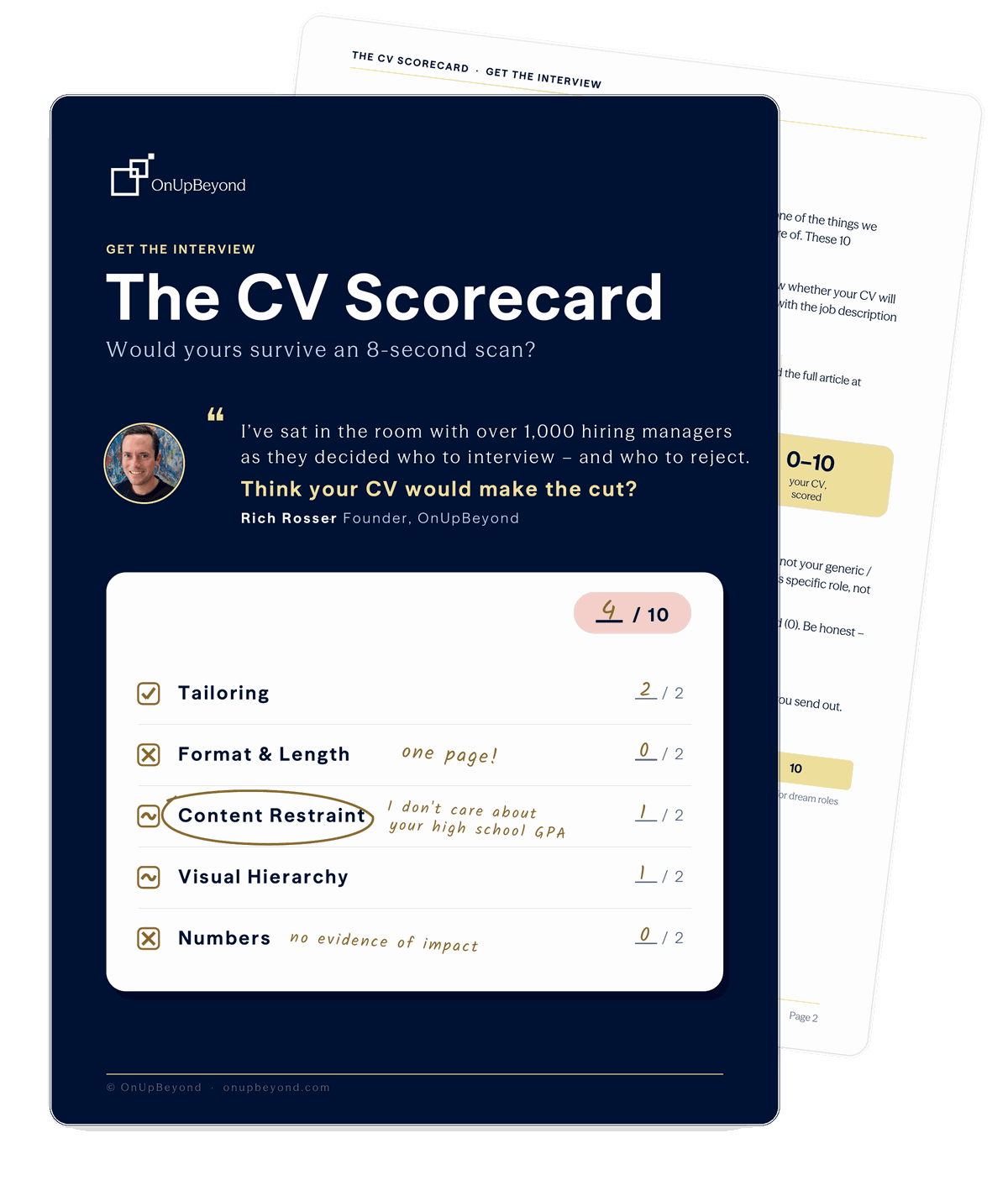
Free with this article: a printable scorecard to rate your CV against all 10 behaviours in under two minutes, plus the full session recording.
Two quick clarifications before we get into it. First, on language: I'll say “CV” throughout for brevity – if you're in the US, read “resume”. Every behaviour below applies identically to both.
Second, when I say “hiring manager”, I mean the boss you'd actually be working for – the chief strategy officer, the transformation director, whoever it is. In practice, that person is often briefing HR or a talent acquisition partner on what they're looking for, so everything below still applies – HR is working as their proxy, translating the hiring manager's priorities back to them.
1I spend very little time on recruitment
Hiring is not their day job. Rightly or wrongly, most hiring managers spend very little time on recruitment – even though you could argue that building the right team is the most important thing a manager does, it gets squeezed by every other competing priority in their actual role.
On top of that, they tend to think it should be easy – there's often a sense that they should be getting more help from HR or talent acquisition.
What it means for your CV: you're writing for an audience that will spend very little time looking at your application in any depth. You need to make it easy for them to immediately understand you're a fit.
2I use your CV to justify why you're picked for interview
There are multiple stakeholders in any hire, and the requirements are agreed in the job description. What's actually happening internally is justification, not evaluation. If you're picked for interview, someone – an HR partner, a colleague, or the hiring manager themselves – has effectively said: "I believe we should interview this person because they demonstrate A, B and C, which you told me matter." If you then don't perform well at interview, nothing bad happens to whoever put you forward – they already justified the decision.
Even in a simple, one-person hiring process, the hiring manager is still doing this same justification, just to themselves: working through why this candidate belongs on the "yes" pile.
What it means for your CV: make it effortless to see exactly how you meet the stated requirements. The easier you make it to justify shortlisting you, the more likely you are to be shortlisted.
3Once you're in the interview, I never critically look at your CV again
As soon as you're through to interview, hiring managers essentially stop referring back to your CV. They might forward it to other stakeholders ahead of later rounds, but they rarely reread it critically. Big exceptions get made for people who interview well, even if their CV was missing something that would have been nice to have.
Think about a typical multi-stage process: a first round with HR, then the chief strategy officer, then perhaps the CFO and a couple of colleagues. Each of them will glance at your CV to orient themselves before the conversation, but nobody comes back to the document afterwards and decides your fate based on it.
What it means for your CV: its entire job is to win you the interview. Everything else – proving yourself, building rapport, answering questions in depth – happens face to face.
4I scan for 8 seconds – I don't read
Something in our brains treats a CV-shaped document differently to a letter. A letter says "read me"; a CV-shaped document says "scan me." Combine that with hiring managers being time-poor, and the average initial scan of a CV comes out at around eight seconds – long enough to read perhaps 80 words if you're reading fast. That's not the total time spent on your application; it's how long it takes to decide whether the next 30–40 seconds are worth spending.
It's also worth knowing this figure isn't fixed. In a tougher jobs market with more applicants per role, scan time tends to fall further, not rise. If you're choosing between a longer CV and a short, punchy one paired with a cover letter, the cover letter is the better bet – the brain reads a letter, rather than scanning it.
What it means for your CV: make it a one-pager. Use a structure and font that signpost. Write short sentences that reward a quick pass.
5I scan in an F-shape
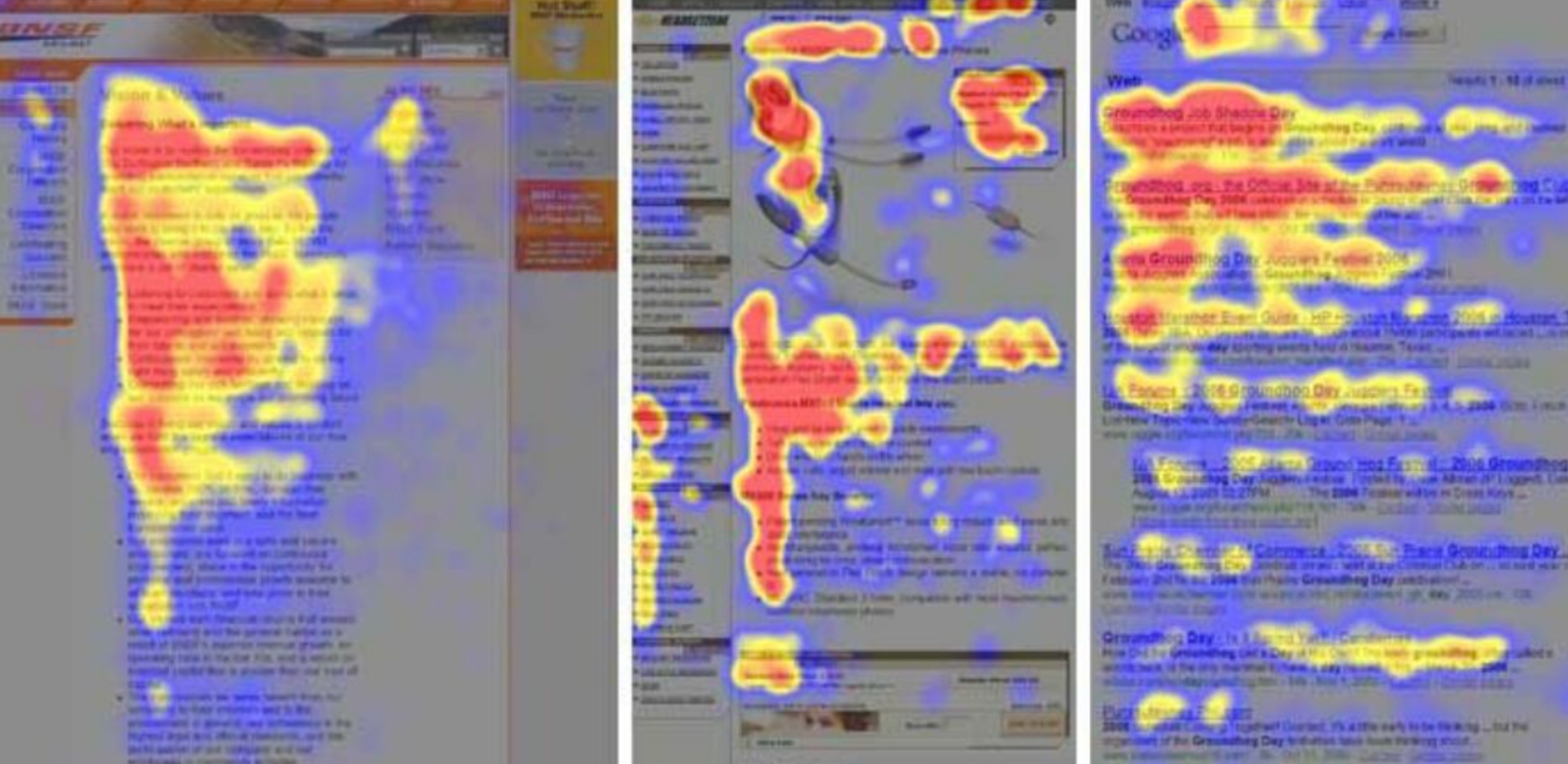
On top of the eight-second limit, eye-tracking research shows people scan documents – CVs, articles, social feeds – in an F-shape: dwelling across the first two or three lines, then scanning straight down the left-hand column. In eight seconds, most readers never make it to a second page.
What it means for your CV: the top three lines and the left-hand third of the page carry almost all the weight. That's where your strongest, most relevant material needs to sit.
Halfway through. Want to score your own CV against these behaviours as you go?
6I know my priority boxes to tick
Every hiring manager going out to fill a role has a short list of priorities in mind for the person joining their team – typically three to six, and usually a mix of skills and experience. A well-written job description tells you exactly what those priorities are, sometimes even split into "must-haves" and "nice-to-haves." Where that structure doesn't exist, the priorities are usually still there in the order the requirements are listed – we naturally put what matters most at the top.
Critically, these requirements change for every single role, right down to the specific words a hiring manager uses for the same underlying thing. That has a real implication: the goal isn't to have one CV. It's to have a tailored version for every application, built around that role's specific top three to six requirements.
What it means for your CV: feature what matches the role in front of you, in the hiring manager's order of priority, and deliberately leave the rest out.
7My own words stand out most easily to me
Because hiring managers are scanning, not reading, they're relying on pattern recognition. If a job description says "people leadership" and your CV says "team management," you might mean exactly the same thing – but on an eight-second scan, that pattern often doesn't register. This isn't hypothetical: it's common to see a hiring manager rule someone out for "not having done much people leadership," even when their CV clearly describes leading a team of forty people, just phrased differently.
What it means for your CV: mirror the exact language of the job description rather than translating it into your own words. Make the pattern recognisable, don't force an interpretation.
8Numbers attract my attention
Numbers – and currency symbols in particular – catch the eye because they break up the pattern of prose, especially inside that F-shaped scan. A £ or $ in front of a figure signals commercial impact almost instantly. Beyond just drawing attention, numbers also reassure: they read as evidence of delivery and results, not just claims.
What it means for your CV: use numbers throughout, including quantified impact in £/$/€ wherever you can genuinely claim it.
9I'm highly sensitive to anything remotely distracting or confusing
There's a useful parallel here with the LIFT model, originally built for improving website conversion rates: anything that distracts or creates anxiety for the reader should come out, even if it's genuinely impressive. Hiring managers are the same – they're only scanning for their specific requirement boxes, and anything less relevant doesn't just get ignored, it actively sows doubt about your focus.
This means being highly selective about what makes the cut, which is uncomfortable, because most of us are taught early on that a CV is where you collect everything impressive about yourself. In reality, it has to be edited down to what resonates with this specific audience – your personalised "greatest hits" for the reader. None of that means the rest of your experience doesn't matter; it just belongs in the interview, where you have the space to bring in extra context.
What it means for your CV: less is more. Cut anything that isn't earning its place against this role's requirements, however good it is.
10If I want more detail, I'll ask for it
A CV that's punchy, focused and lined up against the role's requirements will get the tick – and if a hiring manager wants to know more, they'll ask. That might happen directly at a first-round interview, via an HR partner running an initial screen, or via a third-party recruiter. It happens over email too – a quick "could you send a few bullet points on X before we speak" is common, and it saves everyone time by focusing the actual conversation on what wasn't fully covered in writing.
What it means for your CV: hook the reader first. The follow-up conversation – not the document – is where the fuller picture gets built.
Would your CV survive an 8-second scan?
Score it against all 10 behaviours and get a view on whether your CV is good enough – it takes less than two minutes.
Free
Get your CV scorecard
We'll send it straight to your inbox.
We'll only use this to send your scorecard and occasional OUB emails. Unsubscribe anytime.
From Rich Rosser – ex-McKinsey, founder of OnUpBeyond, and in the room for 1,000+ of these hiring decisions.