
Chart Your Course · Insights
Pay, hours and happiness after consulting
What you really should be optimising for

Rich Rosser, Founder
I've spent nearly two decades watching consultants decide what to do next. First by building The Movemeon Group, where we've supported a community of 70,000+ current and former consultants in landing their next role. Then by building OnUpBeyond and actively helping (ex)consultants make these decisions.
Along the way we've surveyed thousands of them about what they actually earn, the hours they actually work, and how they honestly feel about both. Most people never see this data side by side.
When you do, something surprising jumps out – and it should change what you optimise for in your next move. Here's what we found.
What the data says about life after consulting
Ask a consultant planning their next move what they're optimising for, and you'll usually hear some version of the same answer: better hours, without giving up too much pay.
Sensible. Except the data says something strange.
Startups pay 22.6% below the cross-industry average, with hours no better than average. On paper, one of the worst deals going. Yet when we asked ex-consultants working in startups how satisfied they are with their pay and hours, it turned out they were really happy.
Professional services – a decent deal on paper when you look at pay and hours combined – came dead last for satisfaction.
The numbers below come from our survey of over 4,000 current and former consultants. We asked three things: actual salary, actual weekly hours, and satisfaction with each. Ranking industries on those answers produces three very different league tables – and the differences between them are where the real career insight sits.
Free with this article: the Role Fit Scorecard – rate your current role across the 10 dimensions that really drive career satisfaction, in less than 5 minutes.
If you want the best pay for your hours
Let's start with the league table most people are implicitly using.
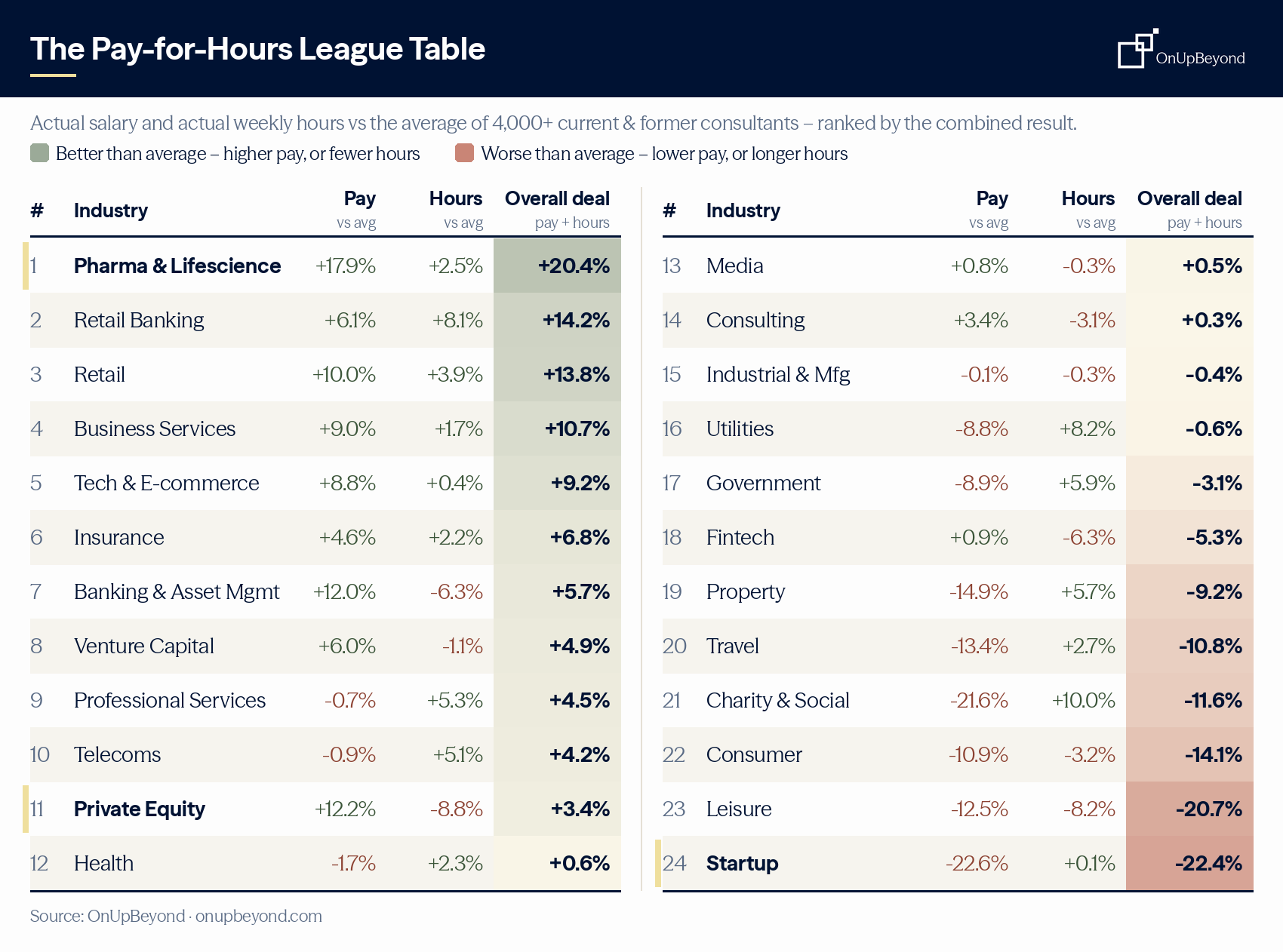
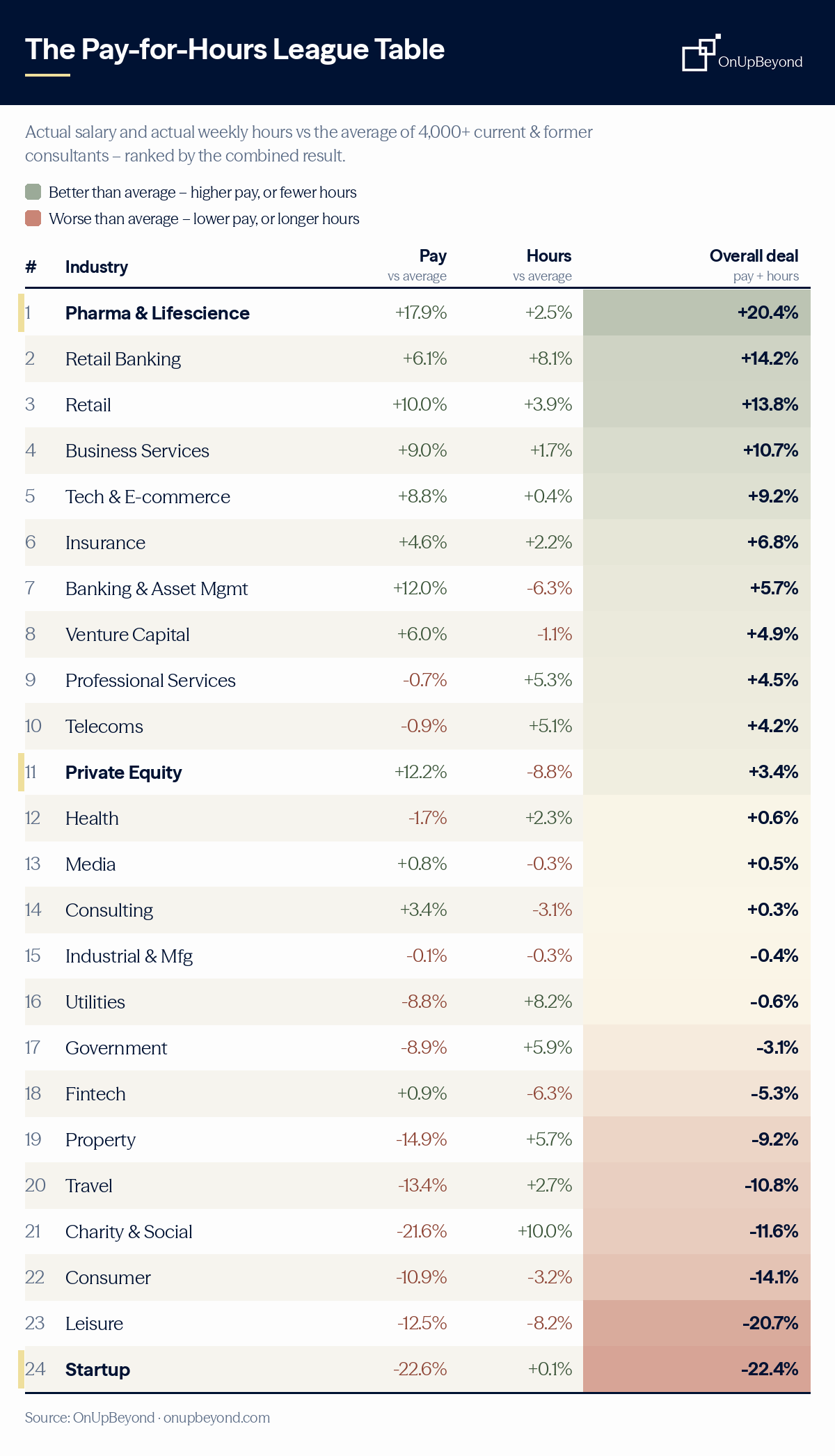
For every industry, we compared actual salaries and actual weekly hours against the average across all respondents. A positive number means better than average – higher pay, and/or fewer hours. Negative means worse. Adding the two together gives each industry a combined score, telling us which industry offers the best overall pay for the hours you put in.
A few things jump out:
Pharma & Lifescience is the standout deal: salaries 17.9% above average, with slightly fewer hours than average too. Retail Banking and Retail follow close behind.
Private Equity pays brilliantly – 12.2% above average – but you pay for it in hours, which are among the longest of any industry. The headline salary flatters the deal.
Startups sit at the bottom: pay 22.6% below average, hours bang on average.
If pay-per-hour is genuinely all you care about, you could stop reading here. But almost nobody actually works that way – as the next table shows.
If you want the highest satisfaction
Now the second league table. Same people, different question: not what you earn and work, but how satisfied you are with what you earn and work. Again, each industry is compared with the overall average – satisfaction with pay, satisfaction with hours, and the two combined in the right-hand column.
The ranking transforms.
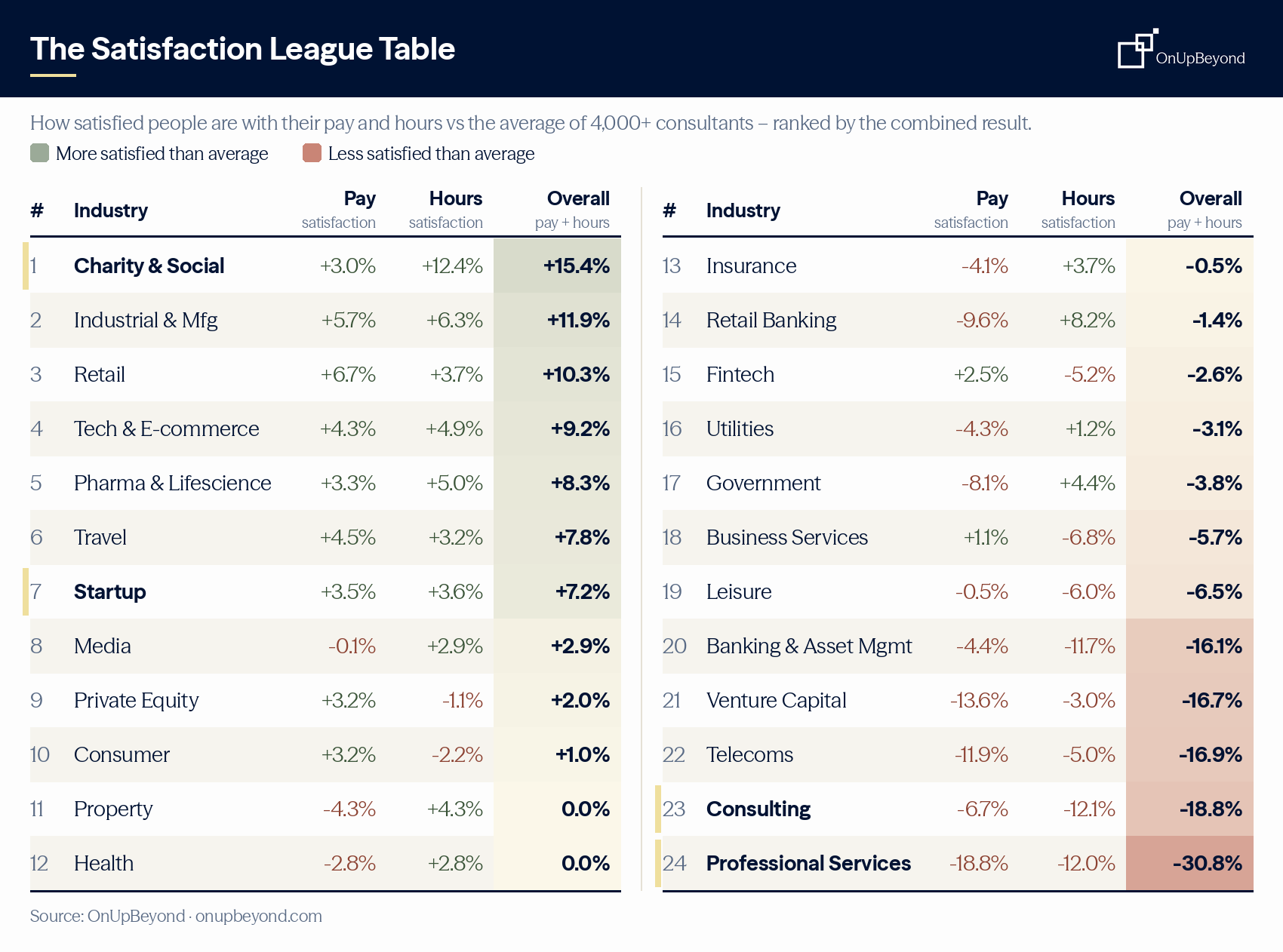
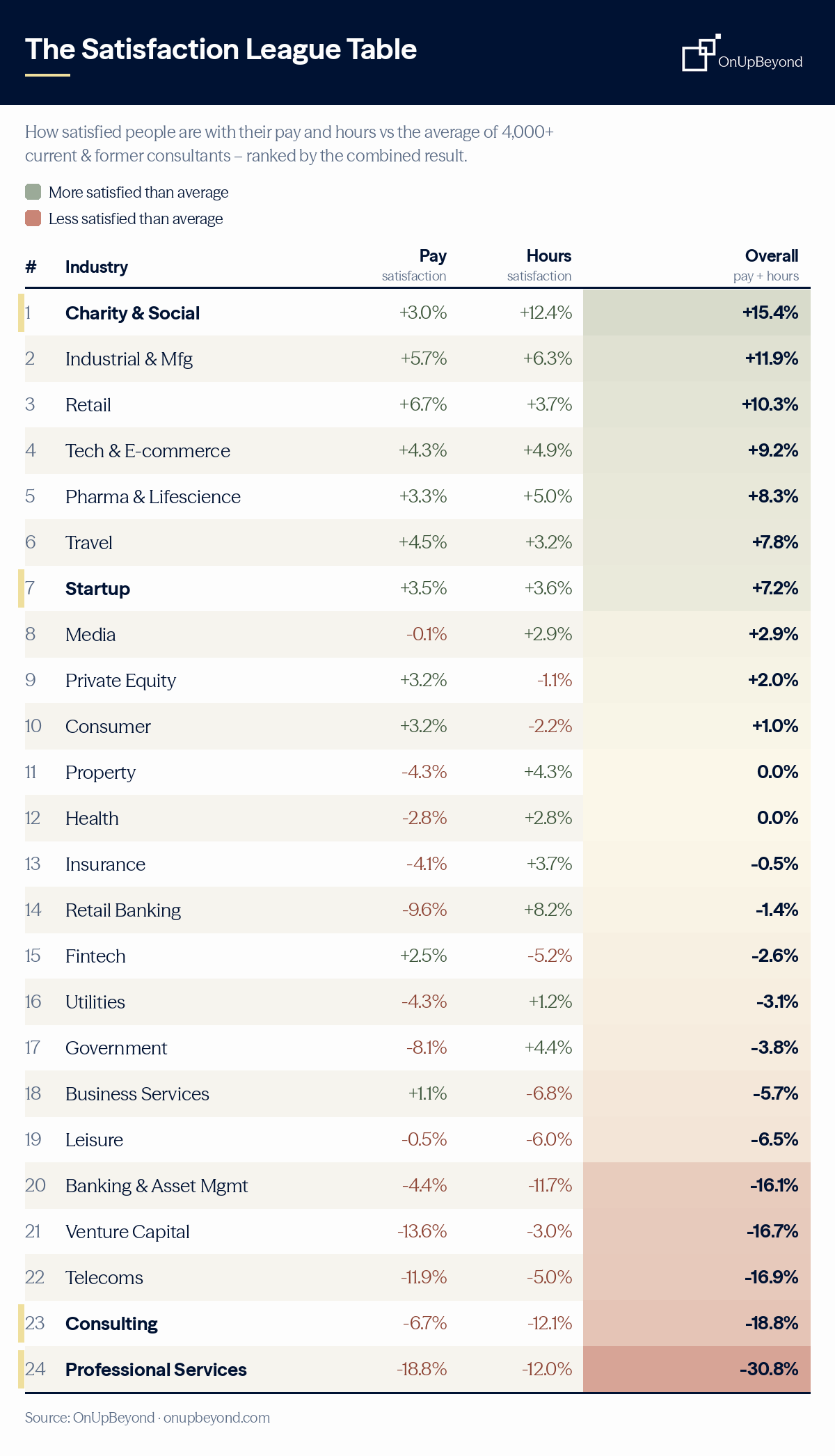
Charity & Social tops the list – despite salaries 21.6% below average. Industrial & Manufacturing is second. Retail, interestingly, holds a top-three spot on both tables – a good deal people also feel good about.
The bottom is just as striking. Professional services ranks last of all 24 industries. Consulting is 23rd. Banking & Asset Management, Venture Capital and Telecoms fill out the bottom five – several of them among the best actual payers in the dataset.
So the industries where people feel best about their pay and hours are largely not the industries with the best pay and hours. Which raises the obvious question: what's going on?
Wondering how your own role really scores against your priorities? Get the Role Fit Scorecard – it takes less than 5 minutes.
Why good pay and hours don't automaticaly make you happy
Here's what you'd expect: if your pay-for-hours is genuinely good, you should be satisfied with it. Reality and feeling should track each other.
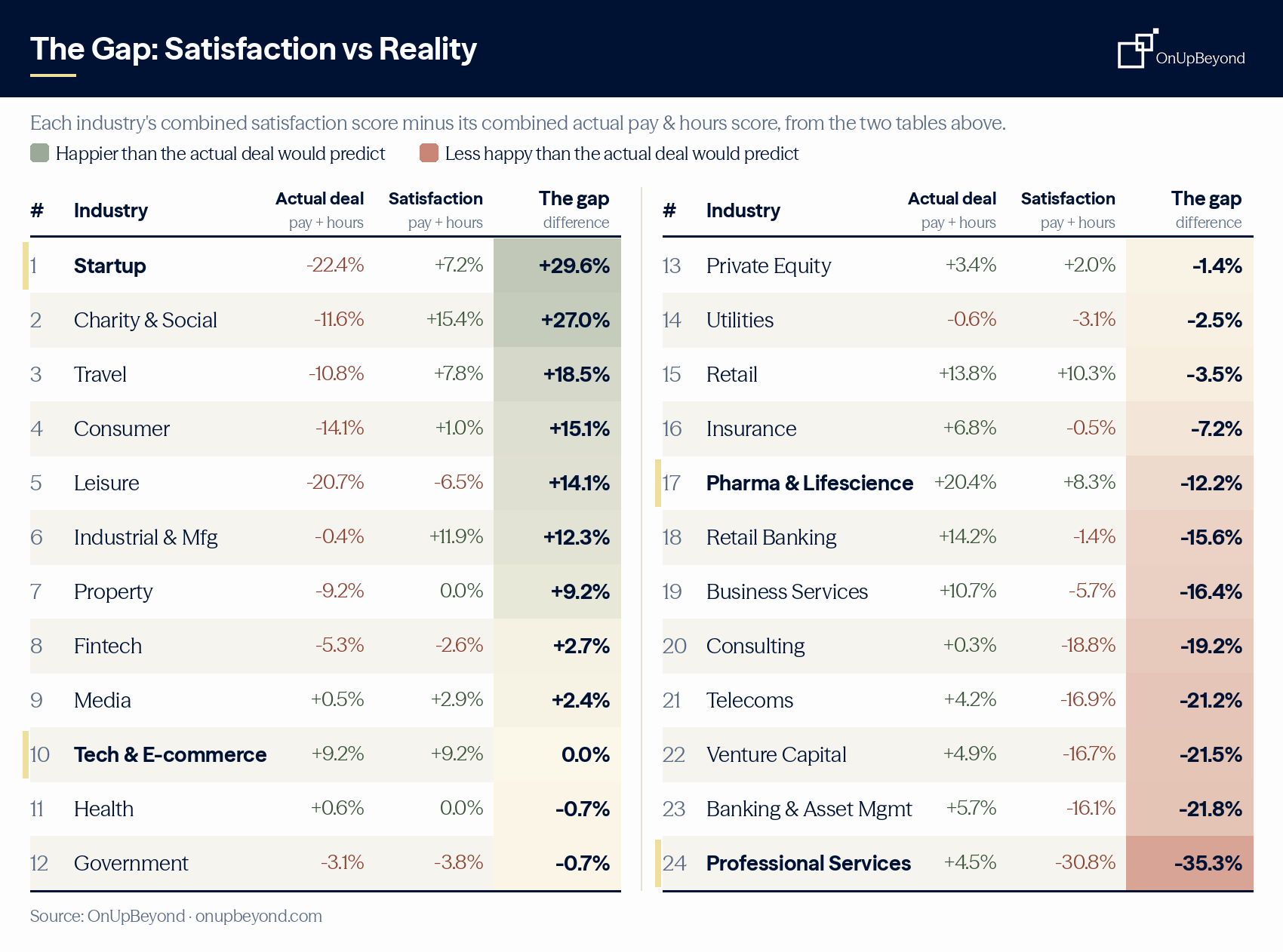
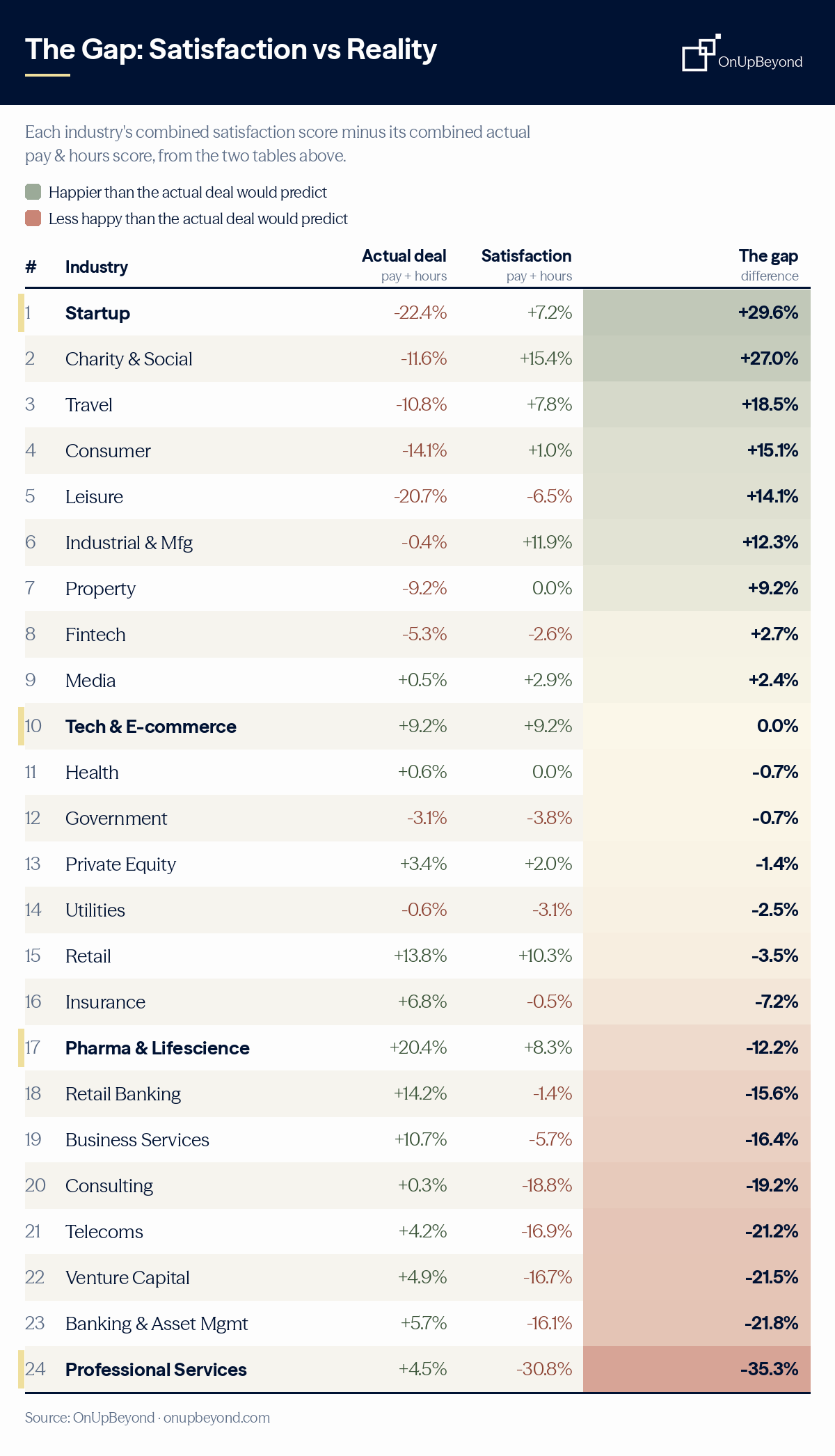
Sometimes they do. Private Equity is a very good example – the combination of hours (very long) and pay (very good) is average (+3.4%). And the satisfaction with hours and pay is pretty average, too (+2.0%). So overall, this is kind of what you'd expect. People work hard and make good money and they're appropriately satisfied with that deal.
But then there are some serious outliers.
The outliers
Startups: bottom of the reality table, yet people's satisfaction runs 29.6% ahead of what their pay and hours justify. In other words, people don't actually get a very good deal but they're very happy.
Professional Services: the reverse is true. Similar to Private Equity, people are very well paid but, in return, work very long hours. But unlike PE, people in Professional Services aren't happy with that deal at all. In fact, they are 35.3% less satisfied than their actual pay and hours warrant. The same picture is true for Consulting, a sub-category of Professional Services – people get an average deal (good pay but long hours) but they're not happy with it at all.
What drives these huge deviations?
In my nearly two decades of watching consultants build careers, I've found that the two main reasons are these...
People want control over their hours (rather than just better hours)
Ex-consultants who start their own company almost invariably work more, not less. But ask them about their happiness and they'll tell you they're much more fulfilled than they used to be and don't mind the hours as much. That's because they feel in the driver's seat.
Compare that with consulting, where your evenings belong to someone else's panic: the client leaning on the Partner, the Partner leaning on the Manager, the Manager leaning on the Associate. People simply don't like the feeling of not having control over their own hours and when they work them. That's why the right measure isn't always "working hours". It's work-life fit.
People say they're unhappy with their pay when deeper stuff is going on
When someone rates their satisfaction with pay, they aren't truly rating pay in isolation – they're rating how happy they are overall. I can guarantee you that a Consulting Partner who feels miserable but is well paid will feel they're underpaid. On the other hand, someone who loves their job and work environment but is paid below-average will often tell you they feel very fairly rewarded.
Pride in your work, belief in the mission, fit with your strengths and values, the colleagues around you: all of it mingles into an overall feeling of how satisfied you are. The same salary feels fair in a role you believe in and insulting in one you resent.
Which means this third index really isn't just measuring pay and hours. It's measuring everything else – all the dimensions of a role that people mash together into "how I feel about my job", without ever pulling them apart.
So what does this mean for your career?
It means that you should get really clear about where your priorities lie.
What I mean by that is not just a vague "I want decent hours and I need to make good money". I mean an actual, quantified assessment of what's most important to you:
- work-life fit
- compensation
- alignment with your values
- colleagues you love to work with
- development potential
- etc.
I can't emphasise enough how important this reflection work is – it separates the people who find real career fulfilment from those who don't.
This reflection should guide both your long-term career direction and your short-term decisions to get to the long-term goal. It informs whether you should make a move, when you should do so and, perhaps most importantly, what type of move you should make.
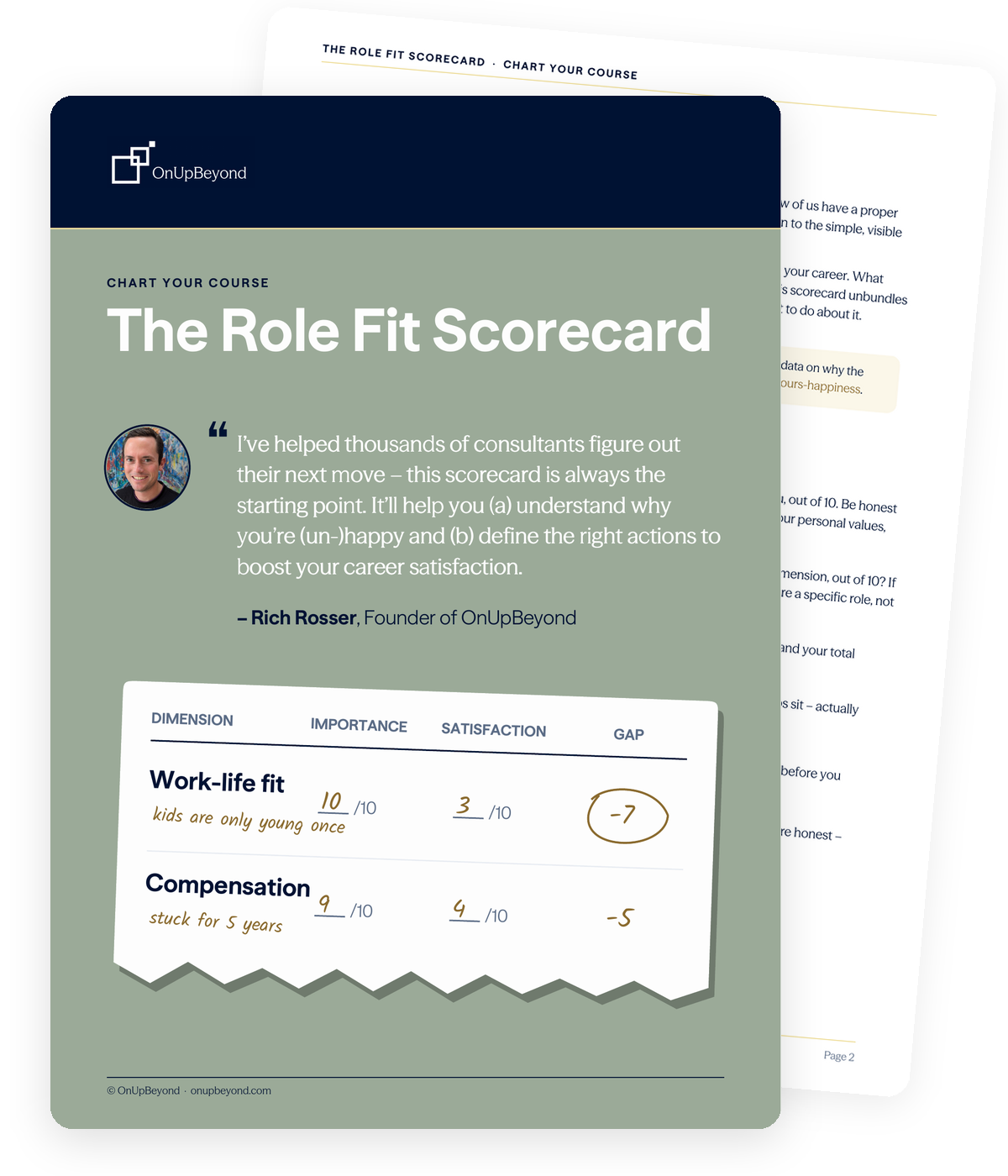
I've found that it's easiest to get clear on your priorities when you're mapping something specific against them. That's what the Role Fit Scorecard below is for: it allows you to map your current (or last) role against the 10 key dimensions of career satisfaction and to identify your biggest gaps. As a result, you'll understand exactly why you feel (un)happy in your role and what the gaps are that your next move has to fix.
Because in the end, you don't want to just run away from something. You want to run towards something that truly excites you.
How satisfied are you in your role?
Score your role across the 10 dimensions that really drive career satisfaction – it takes less than 5 minutes.
Free
Get your Role Fit Scorecard
We'll send it straight to your inbox.
We'll only use this to send your scorecard and occasional OUB emails. Unsubscribe anytime.
From Rich Rosser – ex-McKinsey, founder of OnUpBeyond, built on career data from 70,000+ current and former consultants.