
Land the Offer · Insights
How to work with recruiters
Key facts about the recruitment industry and what it means for you

Matt Wright, former Global CEO, Russell Reynolds Associates
Matt Wright is one of the most senior voices in global executive search. He spent over 20 years at Russell Reynolds Associates, one of the world's largest recruitment firms – leading its global financial services business, then Europe and Asia Pacific, before being elected Global Chief Executive.
Today he sits on boards of various organisations around the world, including BAT, Berry Bros & Rudd, and Cripps Leadership Advisors.
We sat down with Matt for 90 minutes to open up an industry that's notoriously hard to read from the outside – recruitment. This article distils the full conversation.
How recruiters work & how to work with them
"I do get calls from headhunters – just never about the roles I want."
A member sent us this message recently, and it sums up how many current and former consultants experience recruitment: as a black box. You know recruiters sit behind a large share of the roles you'd want. But you don't know how they work, how to get in touch with them and how to tell the good ones from the bad ones.
This article is the full playbook – here's what it covers. Jump straight to any section you're particularly interested in:
Part one: How the recruitment industry actually works
- 1/ Retained search firms: paid to find, not to place
- 2/ Contingent recruiters: paid only when you're hired
- 3/ What the two models mean for you
Part two: How to work with recruiters
- 4/ Getting introduced: the best way in
- 5/ Reaching out cold: how to do it
- 6/ Building real relationships: be honest and helpful
- 7/ Diversifying your relationships: know more than one firm
- 8/ Staying top of mind (without being annoying)
Part three: How to tell whether a recruiter is any good
Part one
How the recruitment industry actually works
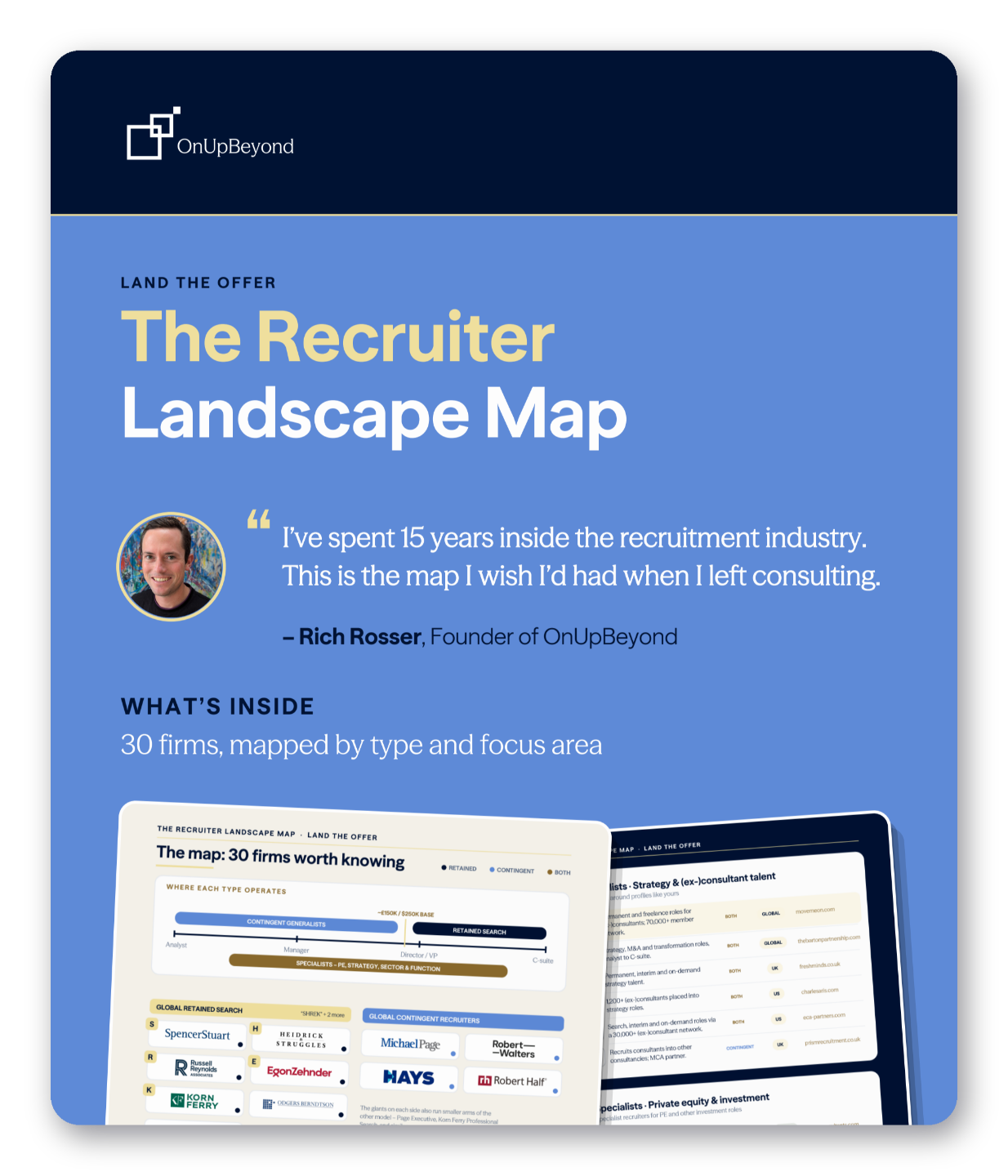
Free with this article: the Recruiter Landscape Map – the firms worth knowing, mapped for (ex-)consultants.
Everything a recruiter does – how much time they give you, whether they call back, whether their advice can be trusted – follows from their business model. Within the world of recruitment, there are two principal models, and they could hardly be more different.
1/ Retained search firms: paid to find, not to place
Retained executive search firms are hired upfront by a company to fill one specific senior mandate: a new CFO, a divisional MD, a board chair. Five giants dominate globally – Spencer Stuart, Heidrick & Struggles, Russell Reynolds, Egon Zehnder and Korn Ferry, known inside the industry by the affectionate acronym "the SHREK firms". Alongside these five behemoths, there is a long tail of excellent sector boutiques.
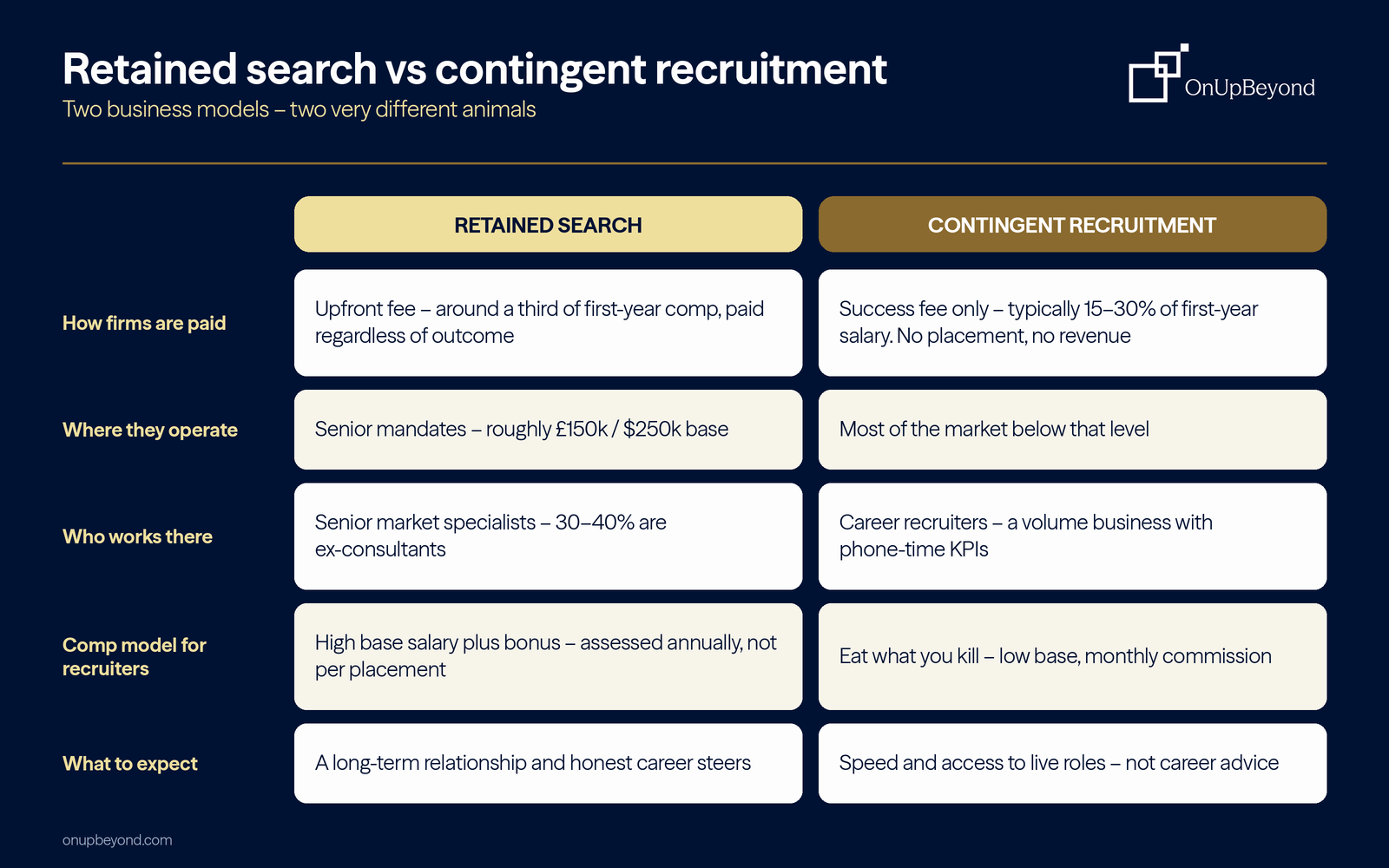
The traditional fee is a third of the role's first-year cash compensation, paid in stages across the opening months. This fee is generally paid regardless of outcome.
Sit with that for a second, because it's the single hardest thing for outsiders to grasp: the search firm gets paid whether or not anyone is ever hired. Why would any company agree to that? Because they're not buying a transaction – they're buying trusted advice. A board hiring a CEO wants a partner who will map the entire world market for that role, assess candidates honestly, and tell them hard truths – including "the person you're describing doesn't exist at that salary" or "your best option is the internal candidate." A recruiter paid only on placement can't say those things; a retained adviser can, and does.
What keeps them honest isn't the fee – it's reputation. Search is a repeat-business industry where a firm's entire value is its credibility. The client's expectation is that a firm of this standing will deliver – if the right person exists, they're expected to be found. The pressure is enormous; it's just reputational rather than financial.
Now, who works inside these firms? Search professionals are genuine market specialists, organised into sector practices (financial services, consumer, healthcare) and functional ones (CFO practice, board practice), backed by large research teams who systematically map every credible candidate for a mandate, worldwide.
30–40% of search professionals have a background in consulting. While you wouldn't typically think of recruiters as ex-consultants, it makes sense for large search firms – they're looking for people who can speak credibly to Boards and C-level execs and who have a real expertise in a specific industry or function.
Base salaries are high – comparable to or better than top-tier consulting – and people are assessed annually on overall contribution, not paid per placement. Nobody in search firms is chasing this month's commission.
Because of how strategic search firms operate and how trusted they are as advisers, they have a huge interest in knowing the best people in their market, even before a mandate exists. They see time spent on a strong candidate as an investment – even if there's no role for you now, you might fit next quarter's search. In Matt's words: "A good search firm's motivation is getting to know great people, so they can put those great people in front of clients."
One boundary: as a rule of thumb, retained search only operates above roughly £150k base in the UK or about $250k+ in the US. Below that, most roles go to contingent recruiters.
2/ Contingent recruiters: paid only when you're hired
Alongside retained search, the other dominant model is contingent recruitment. If someone rings you calling themselves a headhunter, nine times out of ten this is who you're talking to. Contingent recruiters are paid a success fee – typically 15–30% of first-year salary, depending on seniority and how specialist the role is. This fee is paid only if a company hires someone they put forward. No placement, no revenue.
That model breeds a very different animal. Contingent recruiters are mostly career recruiters: they join the industry from university, make a relatively low base salary and always work towards a monthly or quarterly commission. It's eat what you kill.
It's also something of a volume business, and the big generalist firms run it like one – recruiters' time on the phone is literally a tracked KPI, and walking into one of their offices means walking into a room full of people on headsets, working through call lists. Speed and throughput win; this is the recruiter most people picture when they hear the word. And unlike search professionals, they've almost never done your job – their knowledge is about who's hiring, not what the work is like.
Behaviour also varies enormously within this half of the industry. Some contingent firms hold deep client relationships – a company they know well has briefed them on a real role. Others are speculative: they'll fire your CV at companies where they can sniff out a fee, sometimes with no relationship at all.
Now that we've unpacked the different business models, a quick word on terminology. When we say "recruiter" in this article, we mean both – retained search professionals and contingent recruiters. The word "headhunter" means nothing specific. It's informal shorthand that all recruiters use freely – prestigious search firms get called headhunters, and contingent recruiters happily print it on their LinkedIn profiles. So if someone calls themselves a headhunter, you don't know whether they work on a retained or contingent basis.
Neither model is better. But they should shape different expectations – which is exactly what the next section is about.
3/ What the two models mean for you
Always establish which one you're talking to. It's a completely fair opening question, and good recruiters answer it plainly: "Helpful to understand how you work – are you retained or contingent? And on this role, do you have a direct brief from the client?"
Expect advice from a search firm. Don't expect it from a contingent recruiter. A search professional's model rewards knowing you deeply, even before there's a live fit – so once you're genuinely in their circle, they'll give real time and honest career steers: what you'd need to build to be credible for the roles you want, what they're seeing in your market. The more senior you get, the more advisory the relationship becomes. A contingent recruiter can't work that way even with the best intentions: their income is this month's placements, so an hour advising someone with no fee attached is an hour they can't bill anywhere.
Expect far more variance at the contingent end. Search partners are senior almost by construction – nobody hands a six-figure retainer for a CEO search to an unknown, so the people running mandates have long track records and reputations to protect. Contingent recruitment has no such filter: it spans superb, deeply networked specialists and someone who set up shop last month (much more on this in Part three). With search firms your question is mostly which firm covers my market; with contingent recruiters it has to be is this person any good.
Don't take silence personally. Ever been ghosted? Almost certainly not a judgement on you. If a contingent recruiter can't attach a fee to you quickly, you fall off the priority list. To be clear, that doesn't make it good business practice. But it is a reality, especially at the contingent end. The practical conclusion: use contingent recruiters for what they're genuinely excellent at – fast access to specific live roles. Don't expect them to get back to you quickly when they don't have a live role that suits your profile.
Control your CV explicitly. Once you send your CV to a contingent recruiter, it's out there. If you don't want them to distribute it speculatively, you have to be explicit about it. "Here's exactly what I'm looking for. When you have a live brief that fits, call me, talk me through it, and with my agreement you can put me forward." Or you could say "Within this boundary – say, senior strategy roles in large retailers – you may proactively put me forward."
With a search firm, invest for the long term. Build the relationship when nothing is live – that's precisely when it's worth most. And if you're currently below the seniority threshold, don't force it: the big search firms simply aren't your channel yet, and your energy belongs at the contingent and specialist end.
Part two
How to work with recruiters
Not sure which firms should even be on your list? The Recruiter Landscape Map covers them, mapped for (ex-)consultants.
4/ Getting introduced: the best way in
Asked for the most effective way onto a recruiter's radar, Matt's answer was almost apologetically simple: go through someone you know. "It is categorically the most effective way." A former boss, a colleague, anyone with a relationship to the firm – it arrives as a recommended, low-risk route rather than one more CV in a very large pile.
So, ask people in your network whether they're connected to the recruiter(s) you want to meet. If they don't, see if someone in their network could introduce you. The power often lies in your network's network.
5/ Reaching out cold: how to do it
When you do go in cold, remember what's happening on the other side: recruiters of both kinds are paid by companies, not candidates, and CVs pour in daily. A CV attached to "please keep me on file" will, in Matt's words, "get lost in the system."
What to say. What cuts through is a short message that does the recruiter's filing for them:
- Say why you're credible – your skill set and standout achievements, in two or three lines.
- Say exactly what you want – role type, sectors, organisation size, geography, culture.
This is where consultants specifically come unstuck. With a broad, generalist skill set, the honest answer to "what do you want?" is often "well, I could do strategy, or ops, or chief of staff…" – and that instinct is fatal here. It's completely fine to still be weighing several paths privately. But the recruiter in front of you can only file and forward a sharp profile: their credibility with the client depends on presenting someone who obviously fits the brief.
The narrower and clearer your ask to this firm, the more likely they "get it" – and the more placeable you become. A jack of all trades isn't a bigger target; it's an unfileable one.
This clarity bar applies to your CV too. When a recruiter puts you forward, your CV still lands with a hiring manager who'll scan it in seconds, like any other application. If you're not sure whether your CV will survive that scan, read our piece on how to make your CV stand out.
Who to send it to. Target the right person, not the front door. The big firms' websites lay out their sector and functional practices clearly – a note to the relevant practice partner beats a general enquiry every time.
Email or phone? It depends on which half of the industry you're approaching. The contingent end is still a phone business – call minutes are a tracked KPI, people live on headsets, and an introductory call can cut through where an email dies in an inbox of thousands. The retained end works the other way: even a warm phone conversation will usually close with "send us your background in writing", so lead with the crisp written introduction and let the call follow.
6/ Building real relationships: be honest and helpful
Two habits, more than anything else, turn a recruiter contact into a genuine relationship – being helpful when there's nothing in it for you, and being honest about what you actually want.
Take the sourcing call
At some point, a search firm will ring you about a role you're not going to take. Sometimes it's a researcher mapping a market: you're in the sector, the role isn't quite right for you, and they ask, "do you know anyone who might fit?" Sometimes you are the approach – and after you decline, the same question follows: "understood – who else should we be speaking to?"
A lot of people find these calls irritating and get off the phone fast. That's backwards. A sourcing call means you're on the firm's map – and how you handle it decides what kind of entry you are in their system. Be generous and genuinely useful, and you're remembered as connected and helpful: exactly the reputation you want in place when the right mandate lands. Search firms also publish market research and run events constantly; engaging with those is another side door in.
Be honest about the culture you thrive in
Asked what separates the strongest candidates for a given role, Matt named three things: knowledge, expertise – "and the most important one that everybody misses is cultural fit."
Good recruiters understand their clients deeply – which ones run hard-charging, individualistic, sales-driven performance cultures, and which are collegiate, nurturing and developmental. Neither is better; they suit different people, and recruiters know it.
Which is why performing the answers you think they want to hear is a genuinely bad strategy. Tell a recruiter you thrive under pressure in a cutthroat environment when you don't, and the best case is you win a role you'll be miserable in. Be honest instead – about the bosses, pace and environments where you've genuinely done your best work – and you turn their client knowledge into your matching engine: they work with a wide range of companies, and a mandate that truly fits the real you is likely coming.
7/ Diversifying your relationships: know more than one firm
A retained firm cannot headhunt people out of a company it's currently working for. These "off-limits" rules are a matter of basic client trust: you can't take a company's money to find them talent while quietly poaching their people for someone else. The consequence: at any given moment, every search firm has a meaningful slice of the market it simply cannot touch – which is partly why five global giants coexist rather than one winner taking all.
Being known to several firms means that whichever way the off-limits lines fall, someone who rates you can pick up the phone.
8/ Staying top of mind (without being annoying)
How often can you follow up before it becomes noise? Matt's rule of thumb: with an established relationship, quarterly – a short, factual update. What you've achieved this quarter, anything that's changed in what you're looking for. Without an established relationship yet, aim for every six months.
Ideally, add value with your update: share what you're seeing in your market – consolidation, hiring patterns, who's building what. That's when it becomes a real relationship.
Importantly, keep on getting in touch even when you're not looking for a new role. People who "turn on" the outreach only when they're on the job hunt tend to discover their recruiter relationships don't exist and their network has gone cold. Keeping in touch even when you're happy where you are makes the whole relationship a lot less transactional.
Part three
How to tell whether a recruiter is any good
Want the shortlist of firms worth knowing? That's what the Recruiter Landscape Map is for.
9/ Why quality varies so much between recruiters
Before the checklist, it's worth understanding why the quality spread in this industry is so extreme.
Start with the entry requirements: there are none. Recruitment is an almost entirely unregulated industry – no licence, no qualification, no professional body you must join before printing "executive search" on a business card. Anyone with a phone and a LinkedIn account can call themselves a headhunter tomorrow, and some do exactly that.
Then add the economics. At the contingent end, the commission model rewards volume and speed, and the low-base/high-commission structure churns through people – plenty of junior recruiters are gone within a couple of years, which means the person confidently advising you on your career may have been doing the job for six months. None of this means contingent recruiters are bad; the best are superb, deeply networked and in it for decades. It means the range is enormous, and the title tells you nothing about where on the range someone sits.
Retained search filters itself somewhat – nobody wins a six-figure retainer without a track record, so mandates are run by senior people with reputations to protect. Quality therefore tends to be more consistently high.
Where you'll encounter all this depends on where you are: the more senior you get, the more your recruiter contact naturally shifts towards retained search; earlier and mid-career, you'll deal mostly with contingent recruiters.
What it means for you: never infer competence from a job title or a firm's website. Assess every recruiter individually – the checklist below applies to both halves of the industry.
10/ What makes a good (and a not-so-good) recruiter
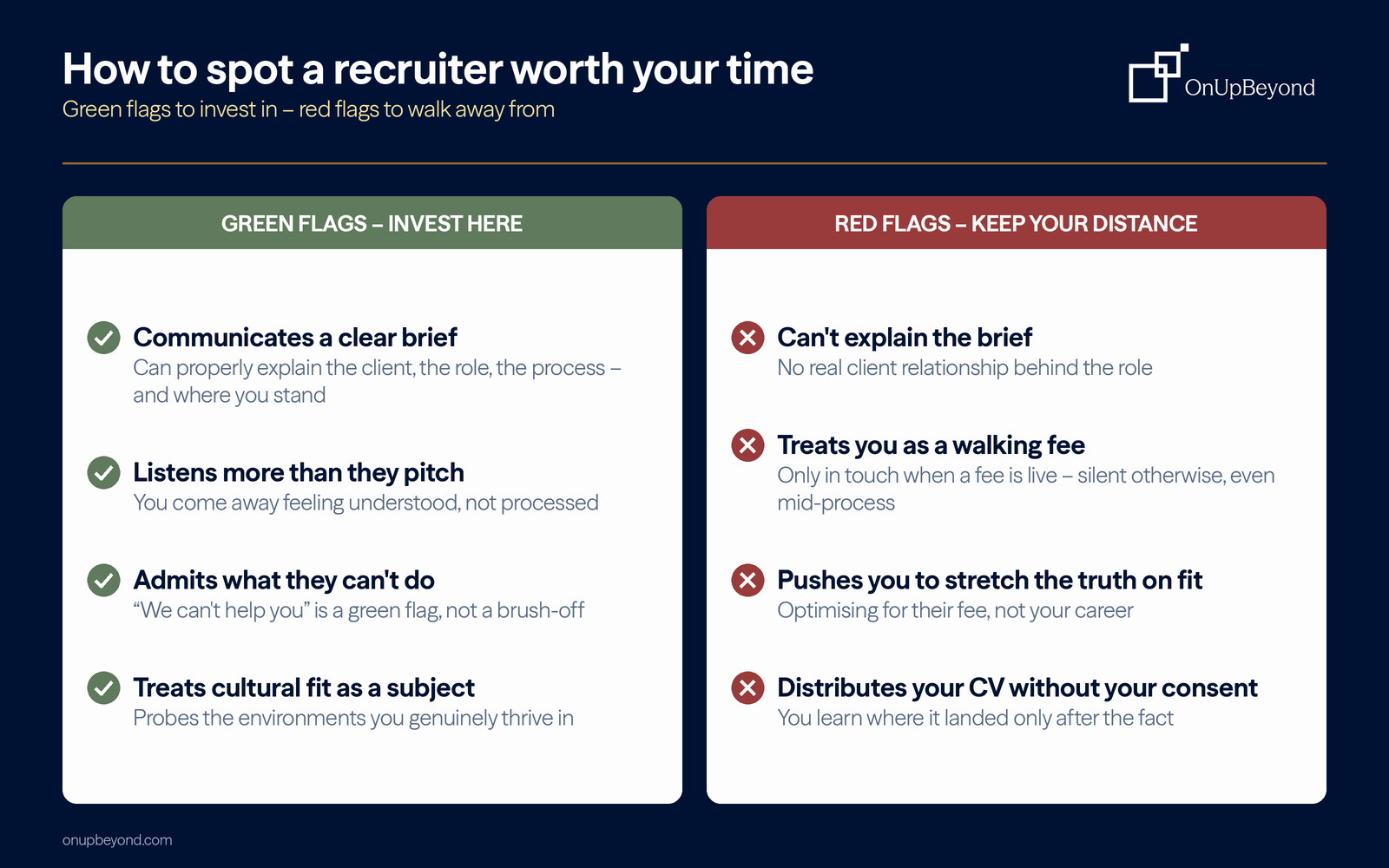
There are four green and four red flags to be aware of:
Green flags – invest here
- They communicate a clear brief. They can properly explain the client, the role, why it exists and the process – and they talk fluently about your sector.
- They listen more than they pitch. The good ones – search or contingent – ask real questions and clearly absorb the answers; you come away feeling understood, not processed.
- They admit what they can't do. "We don't have the client base to help you" or "you're too senior for our roles" is a green flag, not a brush-off – it's a recruiter whose word you can trust when they do call.
- They treat fit as a subject. They probe the environments you thrive in and can describe the client's culture in specifics, not slogans.
Red flags – keep your distance
- They can't explain the brief. If they can't tell you why the role exists, what the client actually needs, or much about the company at all, they almost certainly don't have a real client relationship.
- They treat you as a walking fee. You only hear from them when they need a CV to fill out a client submission; questions about what you actually want get skipped or rushed; they've ghosted you in the past.
- They push you to stretch the truth on fit. Anyone coaching you to be someone else for an interview is optimising for their fee, not your career.
- They distribute your CV without your consent. If it turns up somewhere you never agreed to, the working agreement is broken.
The recruiters worth knowing
Knowing the flags is only half the job – the harder part is knowing which recruiters to approach in the first place. The Recruiter Landscape Map does that work for you: who's who across retained search and contingent recruitment, who specialises in your sector, and where they're active right now – mapped specifically for (ex-)consultants. Download it and turn the list into your outreach list.
Which recruiters should be on your list?
Get the Recruiter Landscape Map – 30 firms worth knowing, mapped for people like you.
Free
Get the Recruiter Landscape Map
We'll send it straight to your inbox.
We'll only use this to send your map and occasional OUB emails. Unsubscribe anytime.
From our 90-minute session with Matt Wright – former Global CEO of Russell Reynolds Associates, one of the world's largest executive search firms.